I just came across a trivial example of a serious problem with big tech. I’ve noticed this with Google since at least 2010 when I was an SEO writer. It has gotten much worse in the last five years, particularly (as we’ve all observed) since Google started producing “AI Overviews.”
As much as Google censors information, erases facts, sanitizes truth, and disseminates propaganda, it creates false information.
In this relatively innocuous example, its “AI” claims Mod Pizza’s cauliflower crust is not gluten free — and goes so far as to assert on Mod’s behalf that Mod doesn’t recommend its own crust options for gluten-sensitive people. It goes even further to say “Mod Pizza recommends that people with Celiac Disease or gluten allergies avoid their restaurant.”
Go to Google’s “reference” links on Mod’s site and you find that Mod’s cauliflower crust is gluten free, and of course it recommends its own GF options. On one of the reference links, Mod says the opposite of “avoid our restaurant.” It says, “Picky Eaters Rejoice! There’s a Pizza for Everyone.”
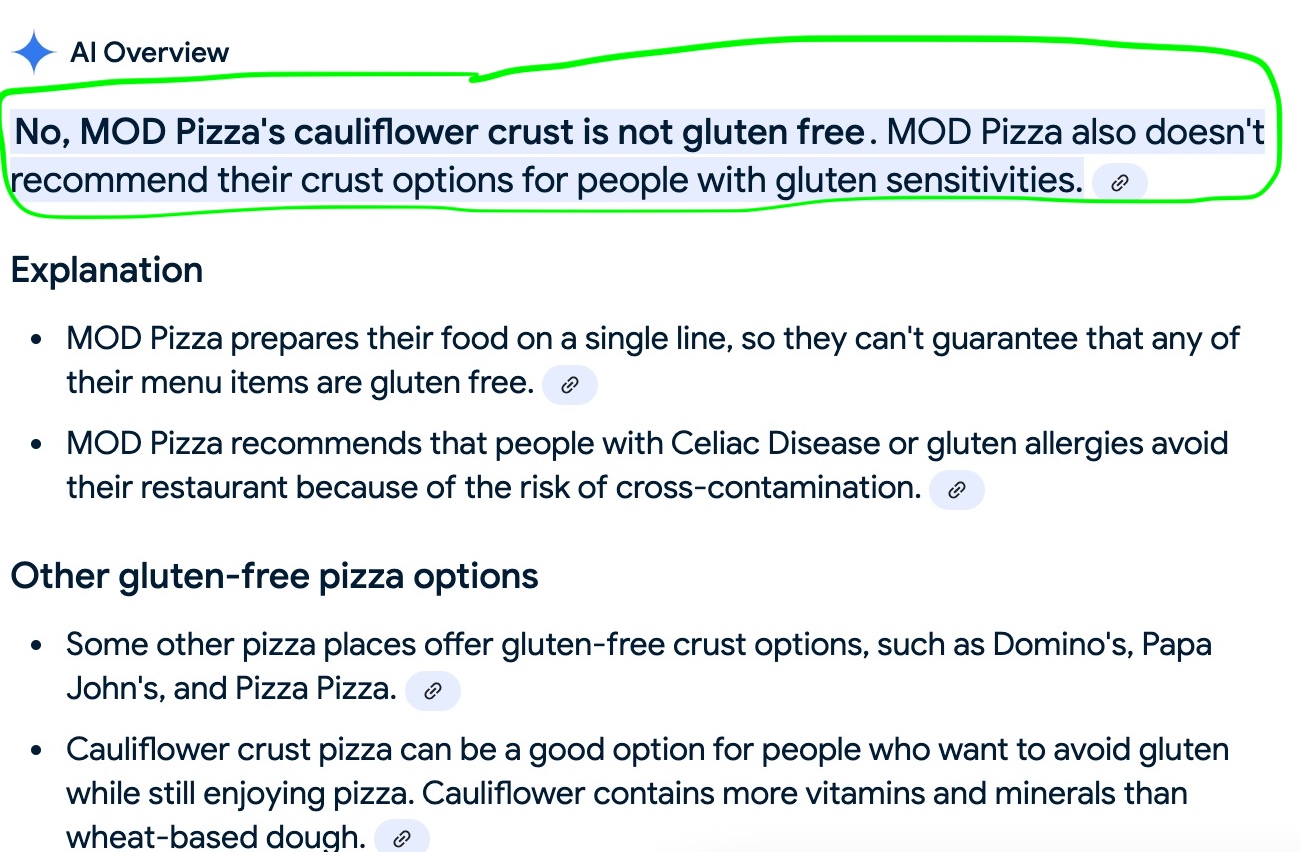


Google’s misinformation is not jeopardizing lives in this case, but it could harm Mod’s business. Say people read Google’s twaddle, decide not to eat at Mod, and tell their gluten-free friends that Mod doesn’t even recommend its own GF options. Those friends tell their friends, and eventually you have a widely spread false rumor that many people believe to be true about a company that actually does a good job of offering a variety of options and relatively simple ingredients. (Is it a coincidence that Google suggests bigger chains “offer gluten-free crust options, such as Domino’s, Papa John’s, and Pizza Pizza”?)
Every time I Google something, whether I already know the answer or not (I often test it), it yields misleading information or contradictory nonsense.
More perilous than pizza
Examples like this are reminders to cultivate discernment and critical thinking. Much more dangerous than mindless, made-up information about pizza is the news that gets churned out by big tech, corporate media, etc.
Recently, a trans woman in the National Guard, Jo Ellis, was said to have piloted a helicopter that crashed into a plane and killed everyone involved. It turned out that Jo was not one of the three pilots.
Why was this news initially misrepresented? Hasty humans and big tech bots drew false conclusions and spewed nonsense with the discernment of a mob of gossip columnists. Slipshod conjecture spread like a game of telephone, and according to The Guardian, some X posts got “hundreds of thousands of views.”
As Jo relates it, she’d just written an article and done a podcast when “the timing of that put me in a nice, delicious algorithm of ‘trans Black Hawk pilot Virginia.'” Apparently, X’s chatbot Grok in particular reported an erroneous surmise about the identity of the third pilot, saying it was Jo and implying she had died and contributed to 67 deaths.
Hats off to the Daily Mail for calling Jo’s cellphone and actually verifying that she’s alive. The much-spurned tabloid did better journalism that day than any fossil of formerly respected news outlets.
Ironically, the word grok, which comes from Robert A. Heinlein’s novel A Stranger in a Strange Land, means “to understand profoundly and intuitively,” as Merriam-Webster puts it.
False reporting happens countless times a day around the world when inchoate bots and sloppy journalists who don’t check references end up belching bullshit — on every groove along the political spectrum.
News that’s confused
Sometimes false and misleading news comes from public service organizations. The Oregon Department of Agriculture misled the public in December last year when it proclaimed it was “confident” that raw food had caused a cat’s avian flu. It asserted: “This cat was strictly an indoor cat; it was not exposed to the virus in its environment.”
But as Truth About Pet Food shows, vet Dr. Laurie Coger filed a Freedom of Information Act request and found that according to the department’s initial report, the cat in question was in the habit of going out on a leash, engaged with “grass outdoors,” and had a “possible exposure” to “waterfowl.”
One of the most invigorating thinkers of our time, psychologist Mattias Desmet, noted recently that a Belgian newspaper reported that Robert F. Kennedy, Jr. crushed live mice and birds for his falcons in a blender. This sensational news apparently came from his cousin Caroline Kennedy in her letter to a senate committee, opposing his nomination as Secretary of the U.S. Department of Health and Human Services. Nowhere in her letter does she say the mice were alive when she’d seen them having been blended (for hawks) over 40 years ago. I can only guess that the provocative adjective “live” was assumed by someone at the newspaper, and no editor throughout the publication process thought to question or verify it. As Desmet put it, the newspaper should rewrite its article and title it “Robert Kennedy Had the Habit of Feeding His Falcons.”
(Or “Hawks.” The newspaper would have to ask Kennedy himself to verify which. Or barring the practice of directly interviewing involved parties to ascertain details, “Raptors” would be an apt choice since it covers both hawks and falcons.)
Survival tools
If we want sanity in our society, it’s crucial to harmonize the qualities that make us human. Two of our capacities, often considered opposites, are actually complementary and are particularly important at this time of heightened misrepresentation, division, and volatility.
The first is the authentic intuition that speaks to us from the core of our being. Not over-emotionalism or defensive gut reactions (which can be mistaken for intuition), but the deep knowing that can spot bullshit and lies instantly. Even when they seem to provide an answer, viewpoint, or solution we need.
The second is critical perception — taking a critical view of everything we see and hear online and on TV. (Follow links. Read source materials!!! Do as Plato and Einstein did and question everything.) Because more often than not, whatever a person, company, or organization’s political affiliations are, their chronicles and conclusions are too frequently ill-founded.
And every incidence of recklessness or deception wreaks collateral damage, major or minor.
I believe this phenomenon is partly unconscious (individuals and organizations that dispatch false “facts” and witless slander are often unaware of their errors when they make them without intention, thoroughness, or wisdom, but they’re still accountable for them and should apologize for and correct them). For example, one believes that RFK, Jr. is such a barbaric “predator” (Caroline’s word) that of course he would grind mice and chicks while they’re alive — the descriptor seems logical and there’s literally no question.
There’s also ample evidence that falsehoods, manipulation, and politically driven, Ministry of Truth-style censorship, slander, and pseudo-fact-checking are more often intentional than many people realize, though none of these particular examples seem to be (I even think the bird-flu one could have been a result of oversight). Fairly often, distortions are mostly due to sloppiness, injudiciousness, panic, a need to seem swiftly definitive and in control, ignorant artificial “intelligence,” and/or the left hand not knowing what the right hand is doing. That said, we should aim to triumph over both conscious and unconscious drives to distort and divide.
Which means that as crazy as it is online and in the world, info police will never help. More constructive is taking responsibility for our own thinking, cultivating immunity to inflammatory headlines that imply what to think, and drawing our own measured conclusions.
Part of that involves freeing ourselves from the destructive belief that vigilantly watching or reading the news is the responsibility of intelligent people. In fact, we all know that the 24/7 (usually flawed or manipulative) reports of horrors across the planet are noxious mentally, emotionally, and physically. Most advertising is also manipulative, and the mega corporations that advertise fund the news and politicians. Making a sharp distinction between staying informed (through well-grounded sources) and constantly absorbing bad news can help restore humanity because, as the observer effect in quantum physics shows, our perceptions and observations influence reality. This doesn’t mean ignoring what’s happening. It means recognizing the horror, doing what we can to help individually and together with others, living the best lives we can, and shifting the mind from horror to focus on creation rather than destruction.
Typing -ai (note the minus sign) after a search term in Google is helpful too because it reduces the amount of off-the-wall results.
One of the most useful survival tools in the crucible we’re undergoing, which demands tectonic societal evolution, is seeing and being resilient to half-truths, plain lies, obtuse errors, and especially the emotional manipulation that pervades the media from all directions. In terms of what gets pumped out on right, left, and centrist channels, there’s both unconscious shaping and deliberate exploitation of the fact that shock and fear sell products, page views, TV ratings, and ideas.
We need to be open not to the drivel that makes us half-informed, reactive, and polarized, but to the complex nature of our world as we realize there’s more to a thing than AI or our media — both of which are manifestations of our collective mind — are currently capable of accurately conveying.
 Erin Harris