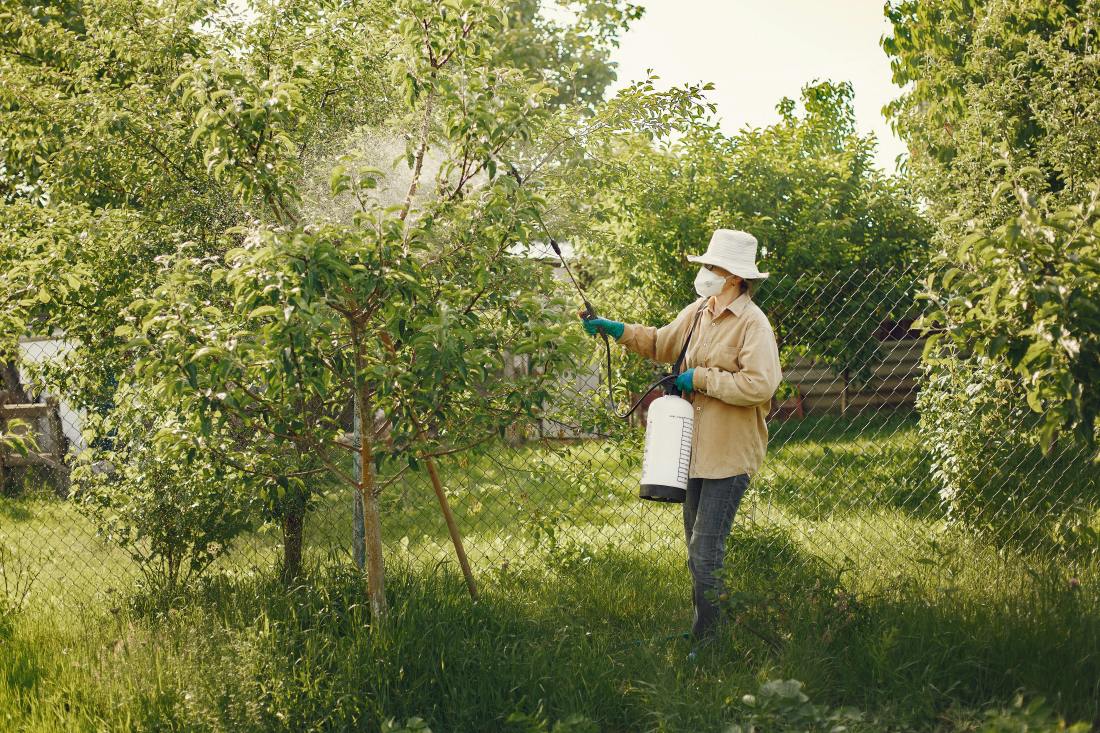
When I smell the fake-sweet chemical odor that signals my neighbor has hired a “pest” control service or sprayed his lawn with herbicides, I close my windows and want to run rather than talk to him.
But pesticides and herbicides damage our health and that of our pets, wildlife, plantlife, air, water, and soil, so we have to talk to each other about toxic lawncare and safer choices. After I and one of my cats went through health crises caused by toxic chemicals, I swore I’d be more outspoken about the poisons that disrupt our bodies.
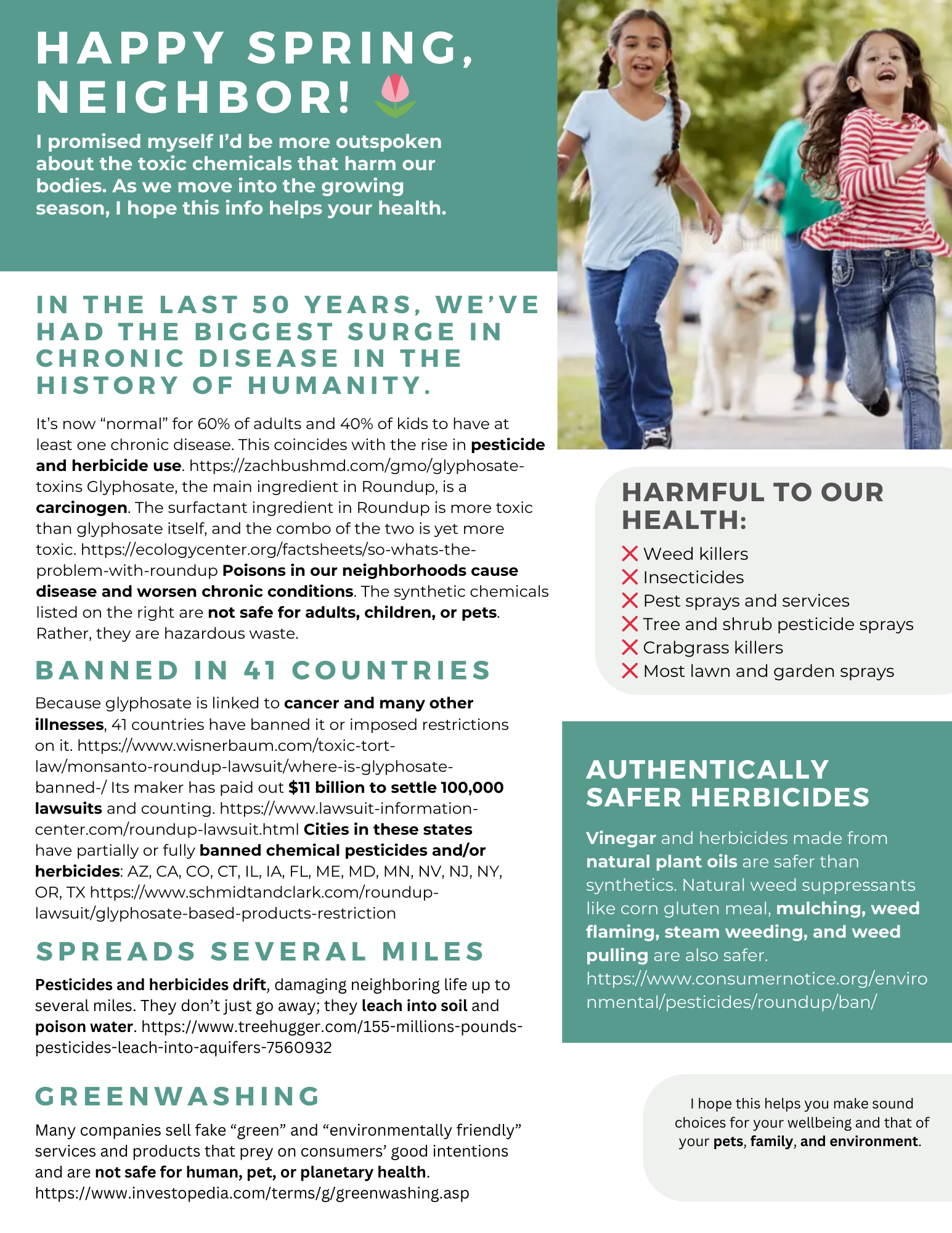
I found that one way to broach the subject is to create a non-preachy flyer educating people on making informed choices. If you’re looking for something diplomatic to pass around your neighborhood, download the flyer at the bottom of this article, or share the following reel. Both summarize the info below.
In the last 50 years, we’ve had the biggest surge of chronic disease in the history of humanity.
It’s now “normal” for 60% of adults and 40% of kids to have at least one chronic disease. These numbers come from the Centers for Disease Control and Prevention (CDC).
This explosion coincides with the escalation of pesticide and herbicide use over the last 50 years, and particularly the last 35 years. Glyphosate, the main ingredient in Roundup, was registered for use in the U.S. in 1974. In the 1990s, the “Roundup Ready” patented line of crop seeds, genetically modified to be sterile and to live while glyphosate kills everything else around them, hit the market.
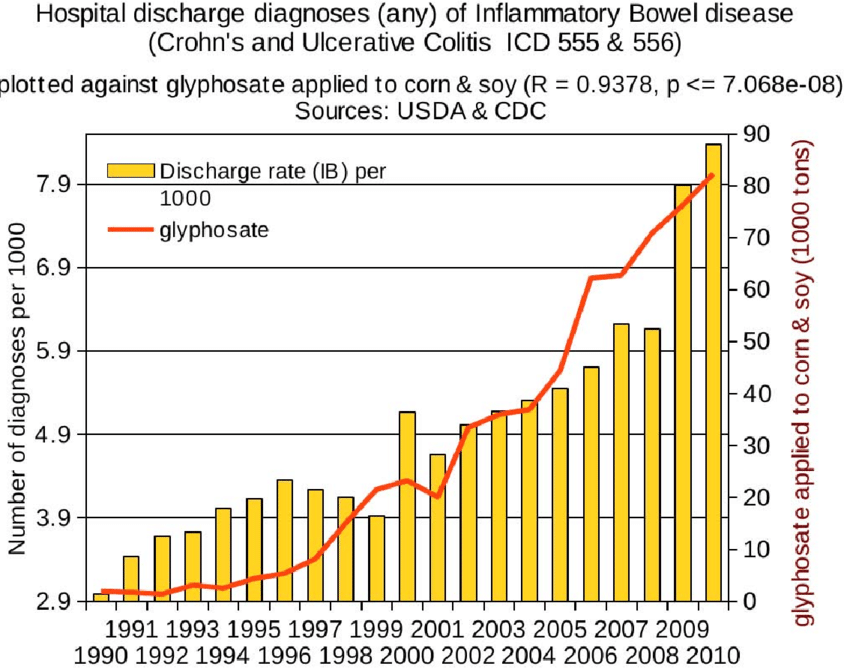
Since the introduction of these “terminator” crops in the 90s, chronic disease has skyrocketed. A 2014 study [PDF] revealed that 22 diseases follow the same pattern as that of IBS shown below, steadily increasing since 1991. The 22 diseases include kidney and liver cancer, autism, Alzheimer’s and dementia, Parkinson’s, and other serious conditions that have shortened or thwarted lives. A 2022 study showed that glyphosate crosses the blood-brain barrier and can have “detrimental effects on the human nervous system.”
Glyphosate is a carcinogen. “The surfactant ingredient in Roundup is more acutely toxic than glyphosate itself and the combination of the two is yet more toxic,” reports the Ecology Center.
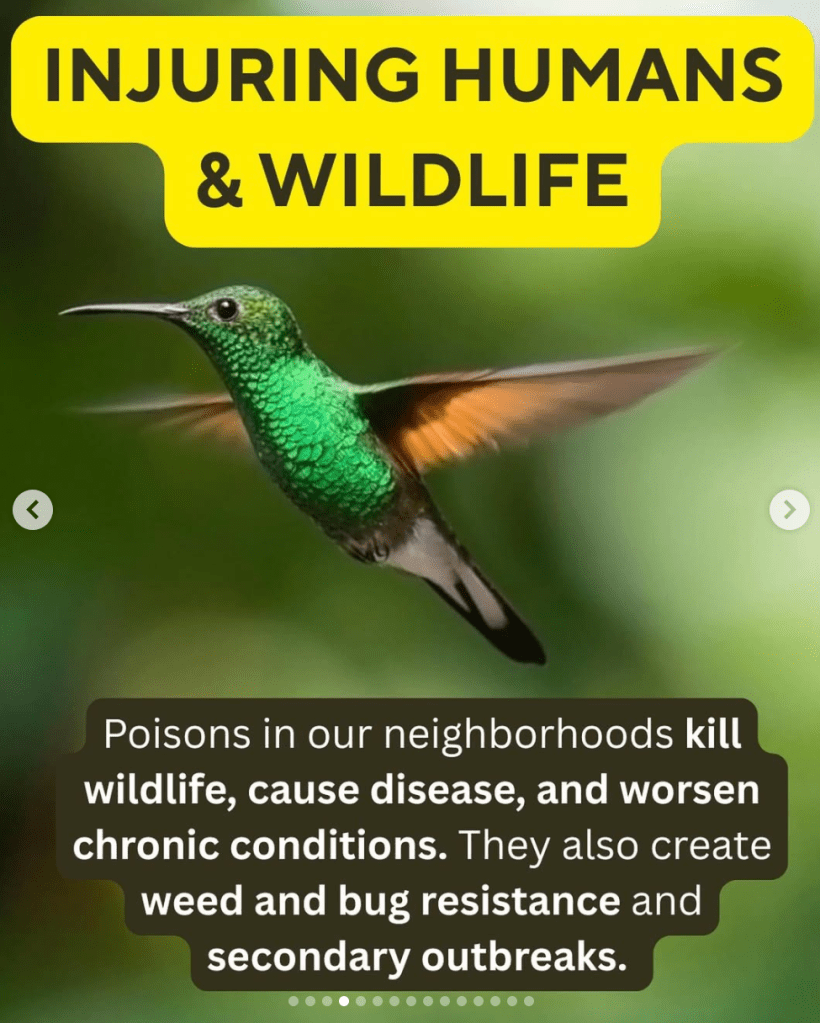
Poisons like glyphosate and other toxic substances (including but not limited to lead, mercury, formaldehyde, benzene, active ingredients in synthetic pesticides, herbicides, and fertilizers, and additives like adjuvants, stabilizers, and dyes) in our neighborhoods cause disease and worsen chronic conditions.
The following synthetic chemicals are not safe for adults, children, or pets. Rather, they are hazardous waste.
Weed killers ❌
Insecticides ❌
Pest sprays and services ❌
Tree and shrub pesticide sprays ❌
Crabgrass killers ❌
Most lawn and garden sprays ❌
Banned in 41 countries
Because glyphosate (as one common example of neighborhood poisons) is linked to cancer and many other illnesses, 41 countries have banned it or imposed restrictions on it. Its maker has paid out $11 billion to settle 100,000 lawsuits and counting. Cities in these states have partially or fully banned pesticides and/or herbicides such as glyphosate and other harmful compounds: AZ, CA, CO, CT, IL, IA, FL, ME, MD, MN, NV, NJ, NY, OR, TX.
Spreads several miles
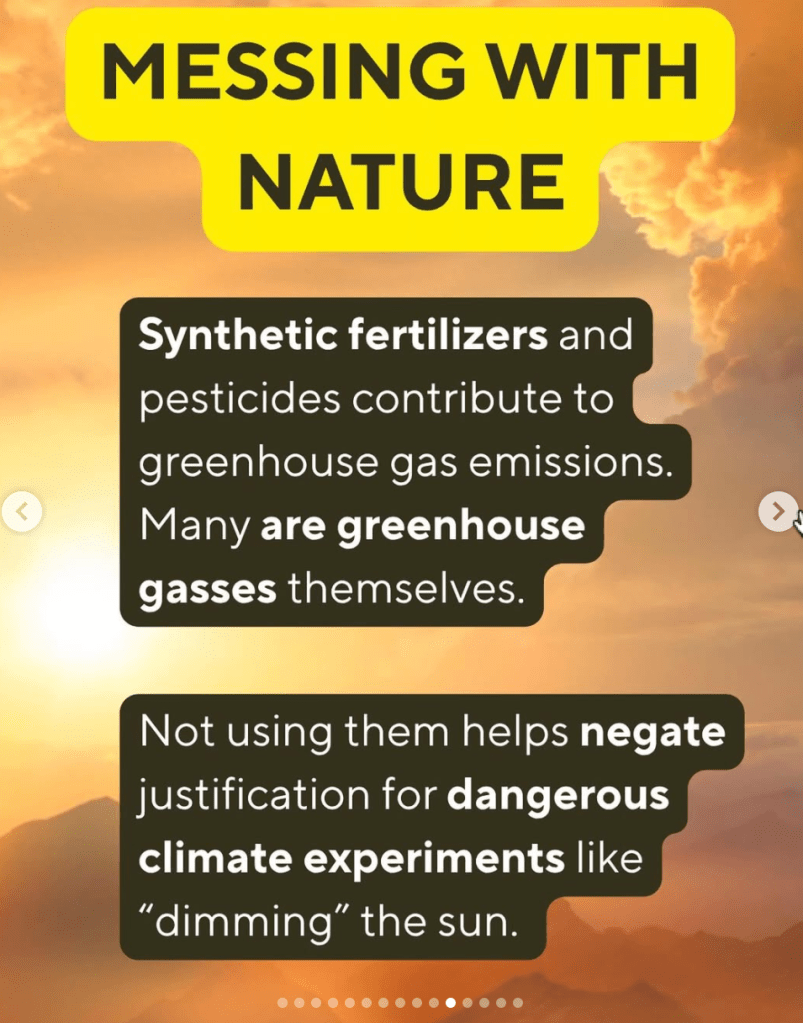
Pesticides and herbicides drift, damaging neighboring life up to several miles. They don’t just go away. They leach into soil, pollute air, and poison water.
Greenwashing
Many companies sell fake “green” and “environmentally friendly” services and products that prey on consumers’ good intentions and are not safe for human, pet, or planetary health.
This includes “green” pest control and “green” lawn care products and services. When you dig deep to discover what’s actually in their products, you find they’re the opposite of safe and eco-friendly. They could be represented as “carbon neutral,” have the word “green” or “nature” in their brand name, purport to be recyclable, or have any combination of false claims. In many cases, the claims of these products and services are clearly counter to logic. Sometimes they’re intentionally misleading with manipulative marketing. In other cases, companies have good intentions but are ignorant or misguided.
More Destruction
Authentically safer herbicides
Vinegar and herbicides made from real plant oils (like neem, thyme, garlic, cinnamon, clove, lemongrass, and wintergreen) are safer than synthetics. Natural weed suppressants like corn gluten meal, mulching, weed flaming, steam weeding, and weed pulling are also safer. Additionally, plants that grow in healthy, fertile soil are less susceptible to weeds and pests. Purchased or homemade compost is solid gold for building rich earth that’s more resilient than weak or dead chemical-laden soil.
Originally written as a Facebook post for my friends in Dec 2020. Updated Nov 2021, April 2022, Aug 2022.
When I was 24, I was struck with a novel illness.
This was a mysterious illness that brought me to my knees for a year and has taken me two decades to even begin to understand.
It started out like a virus with flu symptoms. Then it escalated into an agony that doctors could neither diagnose nor effectively treat.
Early on, I sought the care of MDs — from ER physicians to GPs and specialists.
The day I was given antibiotics and Flonase, a series of alarming symptoms began. On a drive through the mountains, my inner ears became so raw and inflamed that they felt like they’d been shredded. I’ve had ear and hearing problems ever since, and it’s noteworthy that Flonase’s extensive list of side effects includes “ear and labyrinth disorders.” Then I broke out in hives, another noted side effect of both Flonase and the sulfa antibiotic I was given.
Vioxx & 139,000 heart attacks
Directly following the Flonase and the antibiotic, new pains assaulted me daily. I was given Vioxx for pain, and suddenly I felt like an 80,000-pound semi was parked on the left side of my chest. Due to the pressure on my heart area, I couldn’t wear a bra and I could only take shallow breaths.
Headaches manifested, and there were several kinds. One was what I called the baseball-bat headache, where it felt like someone had taken a baseball bat and beaten me in the back of the head. Another was the bleeding-brain headache, where it felt like blood was trickling down the back of my skull as my head pounded.
The pain was so violent that every day for a year I sobbed and begged for the mercy of death.
Fortunately — perhaps because I was young and I didn’t take many doses — an MRI and a CT scan showed that there was no damage to my brain or heart.
Yet it makes sense now when I read that three years after I was in the thick of this, Merck withdrew Vioxx from the market because of concerns “about increased risk of heart attack and stroke associated with long-term, high-dosage use.” Given the chest pain and headaches I had in the short term, heart and brain risks with long-term use are not surprising.
The good thing is that I was at no risk of taking Vioxx in “long-term high dosages” because within days of starting it, I knew that it and the other drugs I’d been given were not only useless for relieving my pain — they were adding symptoms to a growing list of horrors.
Out of nowhere, I struggled with a pounding heartbeat and an unpleasant tingling sensation creeping through my body. These effects are associated with Zyrtec, which I was given for what was written off as “allergies.”
I felt like I’d been poisoned, like I was at the mercy of a toxic substance that had overloaded my body.
I developed digestive problems that prevented food from moving down my esophagus. I have clear memories of trying to enjoy lunch with my grandfather, and feeling hopeless because food wouldn’t move down beyond the pain in my chest.
Because I couldn’t eat properly, I lost too much weight. I became so underweight that one of the holistic practitioners I eventually found wanted to take me by the arm and walk me into her office the first time we met. She later told me that I looked so frail at that time that she wasn’t sure I could walk on my own.
I spent the next few years overcoming all this by seeking help from integrative doctors and holistic health professionals. In the last 20 years, I’ve worked with virtually every healing modality you can think of. I have that difficult year to thank for catalyzing countless positive new ways of being, including my yoga and meditation practice.
And because drugs like Vioxx, Flonase, sulfonamides, and Zyrtec were connected with the increase of my symptoms, since 2001 I’ve kidded that my motto is Just Say No to Drugs. I use that slogan from the Reagan years and the War on Drugs ironically.
What I try to stay away from are most prescription drugs because I know that much of what’s manufactured by pharmaceutical companies is not healthy or safe.
The opioid crisis is a clear example of how pharmaceuticals can be the inverse of healthy and safe. I have a friend whose brother died from OxyContin — and he was one of some 500,000 people whose lives have been harmed or ended by that drug. He was 34 years old.
These facts I’m sharing are no judgment on any drugs you may take or have had your life saved with. I’m simply relating my experience, and other people’s fatalities, together with acknowledgement that some drugs save sick people, and that contemporary medicine has certain strengths.
Weighing choices
I share all this in the hope that you’ll weigh the risks and benefits of the new vaccines very carefully as you make choices for yourself and your family that could have distressing or life-threatening consequences.
As you know, these drugs are new. Analyses of their safety and efficacy are dubious and scarce. Because pharmaceutical companies fund corporate-media television and journalism, emerging data and evaluations are not likely to be unbiased. Because of the grave decline in diligence, truth-seeking, and accuracy in journalism, many reports will be anything but well researched. Rather, they’ll be jerrybuilt with wording pulled verbatim and unquestioned from press releases.
And I’m sure you’re aware that, in this intensely divisive world we find ourselves in, X is a data-proven fact to people on one side of an issue and Y is a data-proven fact to people on the other side of the issue. Numbers are pliable, and more frequently fraudulent than people realize.
In the case of Vioxx, about five years after it was pulled from the market (when the corporate media was publishing more stories in service of public interest), a New York Times article reported that a researcher revealed that data for 21 studies he had authored regarding the efficacy of Vioxx and other drugs had been fabricated.
While it was in use, there were studies that showed its lack of safety, which many doctors at the time were not fully aware of. When it was pulled five years after its release, an FDA analyst estimated that it may have caused between 88,000 and 139,000 heart attacks. About 30% to 40% were fatal. That same year, The Lancet published an editorialcriticizing both Merck and the FDA for continuing to make Vioxx available from 2000 until the recall.
I was given it in 2001. (And when I found early reports at the time indicating a connection between my headaches and chest pain and emerging data about Vioxx’s dangers, doctors dismissed me, saying such dangers were rare.)
In 2006, The Wall Street Journalreported that FDA data indicated “that patients in a Vioxx clinical trial had suffered more heart attacks than the original [New England Journal of Medicine] article about the trial reported.”
Not every prescription drug has a history as sordid as Vioxx’s or OxyContin’s. But far too many do (see why pharmacovigilance developed). We live in a world where the dubious nature of novel drugs is an overlooked threat to our health and safety. It’s especially dangerous to life when threats masquerade as salvation.
Truth is vital
That’s why it’s crucial to do deep research. Because our health and our lives depend on it, it’s paramount to dig into what a report or a statistic truly means. As part of that, we need to really look at where we’re getting our information from. Most of what’s in the legacy media about the new vaccines is marketing material. The Canadian Covid Care Alliance breaks down clearly and simply why “95% effective” is misleading. The data use relative risk, which the FDA said (in 2011) can create “undue influence” and “suboptimal decisions.”
“Patients are unduly influenced when risk information is presented using a relative risk approach; this can result in suboptimal decisions. Thus, an absolute risk format should be used.
I appreciate Dr. Dhand because he advocates critical thinking and the appropriate medical intervention(s) for each individual.
Outer and inner resources
In terms of what’s being reported in the corporate media — whether it has to do with covid or something else — ask yourself, “Do I feel fear, anxiety, overwhelm, or hopelessness when I watch or read the news?”
The world has been rife with turbulence and horror throughout our known history, so that’s partly to be expected. But the best resources should make us feel enlightened by balanced wisdom and inspired to take safe, positive action in self-directed ways.
And really, to get truth now rather than five years from now, it’s wise to spend a good amount of time turning all media off and accessing our own deepest intelligence.
My experience has taught me that when we routinely focus our attention on the ever-streaming torrent of distorted information and rely primarily on outside sources to tell us what’s going on, we’re not using the power of our minds as well as we are when we rely primarily on our inner wisdom for our highest truth.
I understand that the virus is threatening and that people are doing everything they can to protect themselves and others. I know you’ll make the best decisions for yourself, and I urge you to respect the decisions that other people make too. A brand-new, novel, shoddily tested, and fastest-to-market-ever vaccine is not for everyone, but it is for some.
A serious question for everyone should be, “What might the known side effects be six months, or three years from now?” (Update two years later: a population-based study of about three million Italians suggests that “mRNA vaccines are associated with myocarditis/pericarditis in the population younger than 40 years.” This study is one of dozens around the world showing similar results. Heart complications are now often written off as “mild” and “rare,” but the reality is that even mild heart conditions, which are increasingly not rare, can have long-term consequences, which any critical-thinking person would recognize as alarming.)
“Uncertainty” was a commonly used word in 2020. Its prolific use was tedious, but it was an apt word because a lot was and is uncertain. Uncertainty is a condition of life on Earth, and it’s been compounded.
I think “Responsibility” is a word for 2021.
2020 crushed our systems because they were broken — and in 2021, it’s the responsibility of each of us to cultivate awareness and make decisions that will affect how we revolutionize everything in the completely new world we’re slowly creating, whether we recognize the process or not. (The way you choose to educate your kids will affect how we rebuild education. How you choose to handle the virus will affect how we evolve healthcare.)
Our personal decisions can seem small, but their ripple effects are boundless.
With that, we’re more responsible than ever for our physical and emotional health, our ongoing development, our thoughts, our attention, our actions… and for making decisions that balance our individual choices with love, personal and collective progress, open-mindedness, and freedom.
I also think it’s important to be cautious about putting excess faith into the modern religion of Science. Science in its highest form involves humility (not finality) regarding the hypotheses that are tested, and it often involves time when it comes to testing those hypotheses or testing them again with different variables or new information. Equally innovative but less trustworthy is a scramble to create products that involve testing their long-term safety on millions of people.
While Merck agreed to pay$4.85 billion to settle about 27,000 Vioxx lawsuits, the National Childhood Vaccine Injury Actprevents vaccine makers from being liable for damages to any and all sacred bodies and lives.
As it’s phrased, it “provides that no vaccine manufacturer shall be liable in a civil action for damages arising from a vaccine-related injury or death.”
Let’s hope that in the events that it’s necessary, this “Additional Remedy” is honored: “a manufacturer may be held liable where: (1) such manufacturer engaged in the fraudulent or intentional withholding of information; or (2) such manufacturer failed to exercise due care.”




 Erin Harris